

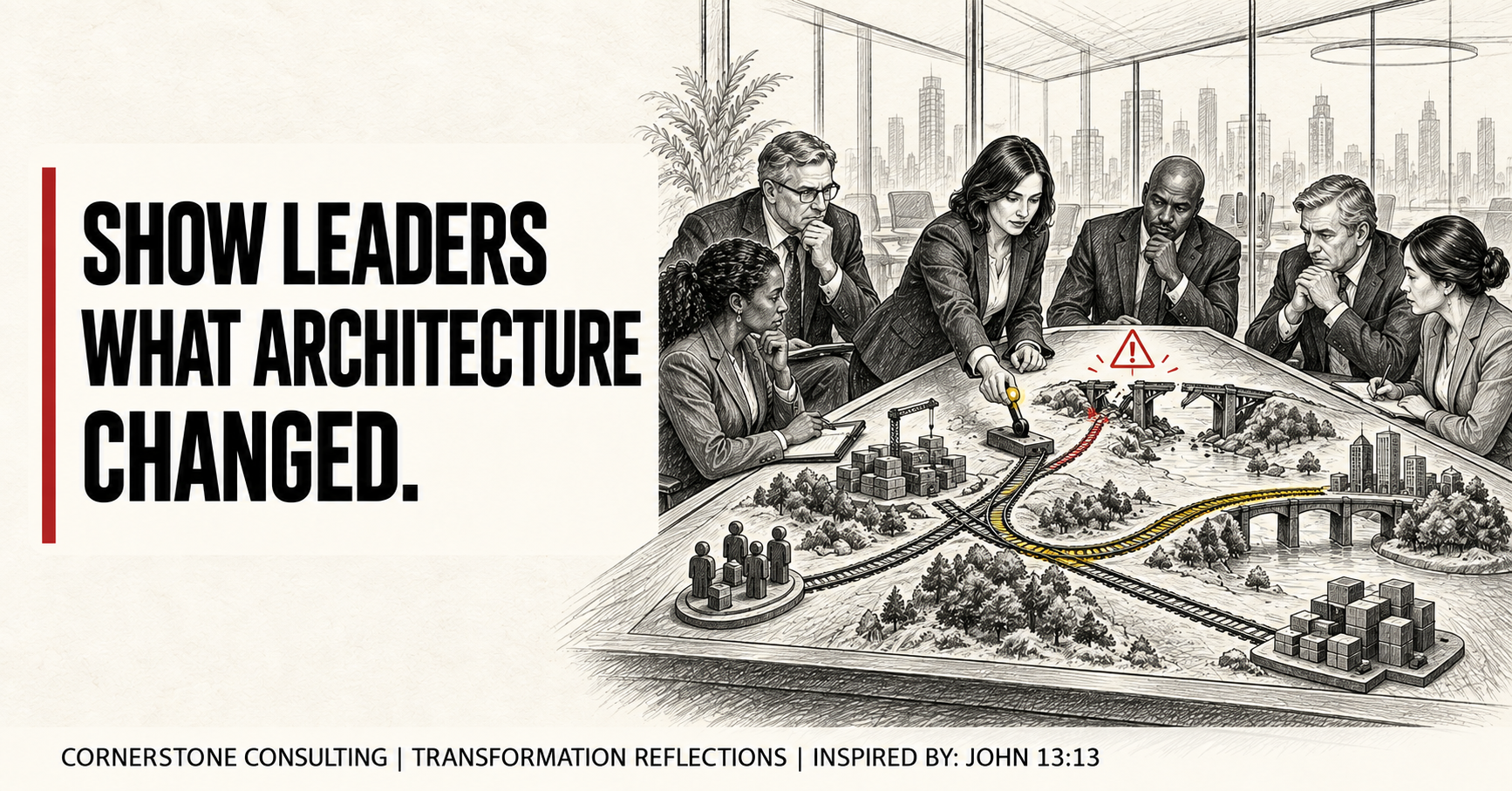
Most architects report what they completed.
Fewer show what changed because architecture was there.
Leaders notice the difference.
I have seen architecture influence grow when leaders could connect the work to better investment choices, fewer surprises, and clearer ownership. The point was not more architecture activity. The point was visible business impact.
Enterprise Architects often want more authority in enterprise decisions. That is understandable. By the time architecture is asked to review a solution, many of the important choices may already be locked in: funding, vendor direction, operating model assumptions, data ownership, integration approach, and delivery timeline.
But influence rarely grows because an architect insists on it. It grows when leaders can see that architecture changes the quality of the decision.
That means activity is not enough. A full calendar of review boards, principles, diagrams, standards, and roadmaps can still leave executives wondering what improved. Did the enterprise avoid a costly dependency? Did a capability decision become clearer? Was a risk surfaced early enough to change the investment? Did the SAP or core-system impact become visible before a commitment was made? Did ownership move from assumption to accountability?
Authority follows useful evidence.
For an Enterprise Architect, this creates a practical shift. Do not only report what architecture produced. Report what architecture helped the enterprise decide, avoid, sequence, simplify, or own. Replace “we completed the review” with “the review changed the decision in these three ways.” Replace “the roadmap was updated” with “the roadmap now shows which dependency controls the release sequence.” Replace “standards were applied” with “the standard prevented three incompatible patterns from becoming operating cost.”
This is not self-promotion. It is translation. Executives do not need architecture to defend its existence. They need to know whether enterprise decisions are getting better because architecture is present.
The architect’s daily discipline is to connect every activity to a consequence. If a workshop does not change a decision, clarify an assumption, or expose an ownership issue, say so and improve the next intervention. If it does, capture the evidence while it is fresh. Small proof points become the basis for a more mature mandate.
Reflection
Where are you asking for more authority when the stronger move may be to make architecture impact more visible?
Practice
Create a simple EA value scorecard for one active initiative. Track five outcomes: decision improved, risk surfaced early, dependency clarified, ownership assigned, and complexity avoided. Use it in the next executive conversation.
Comments Welcome
Darin Paton is the Owner of Cornerstone Consulting Inc., an Alberta-based enterprise architecture and SAP ERP transformation advisory firm serving organizations across complex business and technology change for over 15 years. 30+ years as an EA and advising SAP transformations.

Leave a Reply