

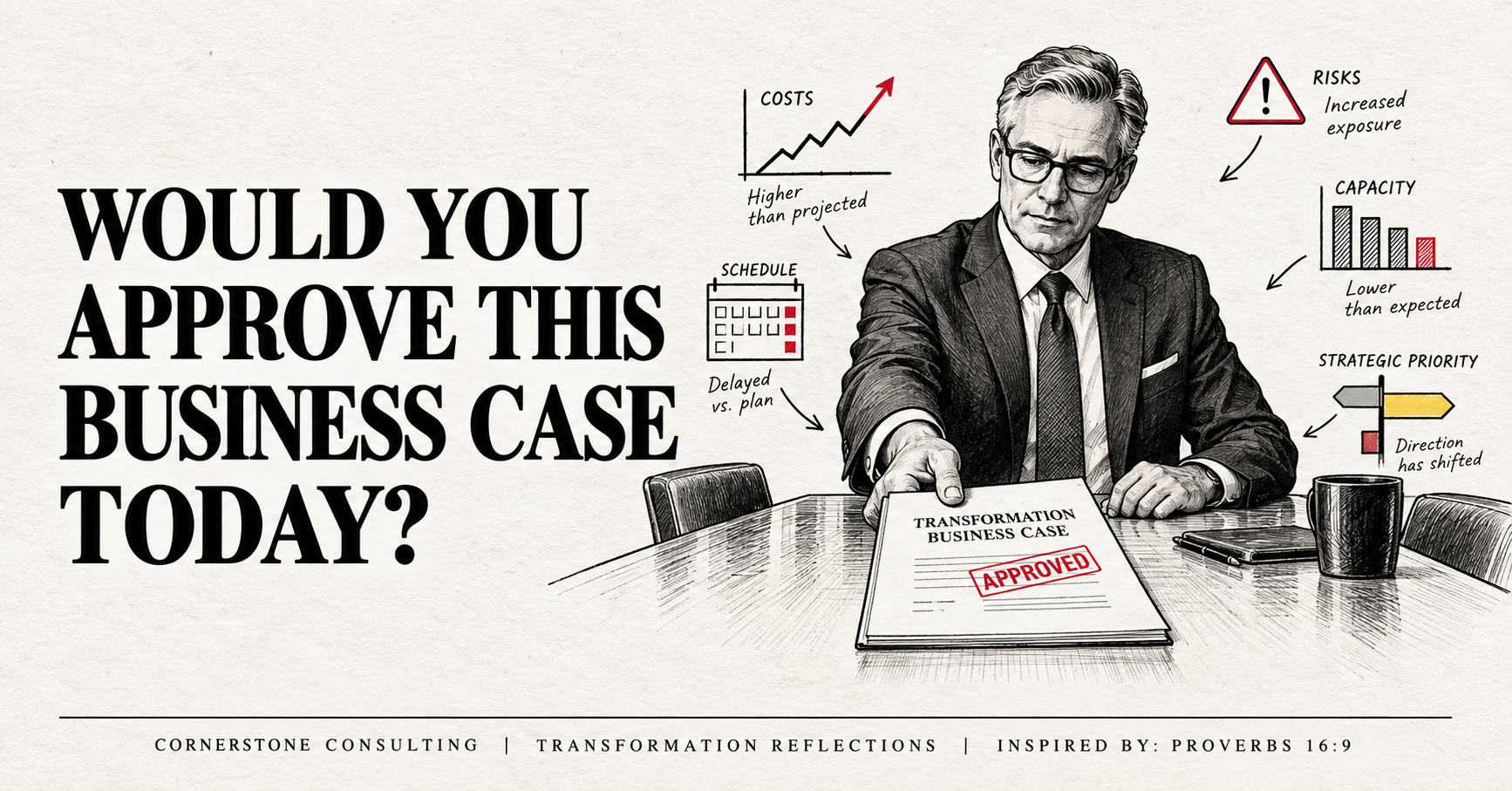
The business case was approved.
The conditions behind it have changed.
Would your executive team still fund it today?
I have seen business cases become untouchable long after the conditions behind them changed. Teams knew the economics, capacity, and risks had moved, but governance kept defending the original approval. Better decisions began when leaders asked whether they would still fund the same proposal today.
A business case is created before the organization has learned what the transformation will actually require.
At approval, leaders estimate demand, cost, timing, capacity, risk, adoption, and benefits. Those estimates are necessary. The problem begins when the approved case stops being a decision tool and becomes a contract that no one is permitted to question.
Conditions rarely remain still. Customer behavior shifts. Regulations change. Integration complexity becomes visible. Workforce capacity tightens. A vendor changes its commercial model. A new strategic priority competes for capital. Yet governance may continue to defend the original scope, schedule, and benefits because changing them feels like admitting failure.
That is how the business case becomes the constraint.
The danger is not merely inaccurate forecasting. It is decision lock-in. Leaders keep funding the original logic even after the economics, operating model, or strategic value have changed. Teams then spend energy protecting approval rather than improving the investment.
A mature executive response treats the business case as a living investment thesis. The question is not whether every original estimate proved correct. The question is whether the initiative still deserves capital, capacity, and leadership attention under current conditions.
This requires disciplined reauthorization. What has changed since approval? Which benefits remain credible? Which costs or risks have moved? What new options now exist? What would we choose if this proposal arrived today, without sunk cost or reputation attached?
Enterprise architecture and independent transformation assurance can help connect the revised case to current capabilities, process impacts, information needs, technology choices, dependencies, and operating-model consequences. The purpose is not to reopen every decision continuously. It is to prevent yesterday’s logic from governing a different enterprise.
Strong governance protects value, not paperwork. Sometimes that means continuing with confidence. Sometimes it means reshaping scope, changing the sequence, pausing investment, or stopping. The courageous choice is the one supported by today’s facts.
Reflection
Which part of the approved business case is still governing the transformation even though the market, economics, operating conditions, or strategic priorities have changed? What would the executive team choose if the investment arrived for approval today?
Practice
Run a quarterly investment-thesis reauthorization. For one major initiative, record what has changed since approval, which benefits remain credible, which costs and risks have moved, what new options now exist, and the executive choice: continue, reshape, pause, or stop. Document the decision and the evidence supporting it.
Comments Welcome
Darin Paton is the Owner of Cornerstone Consulting Inc., an Alberta-based enterprise architecture and SAP ERP transformation advisory firm serving organizations across complex business and technology change for over 15 years. 30+ years as an EA and advising SAP transformations.

Leave a Reply