

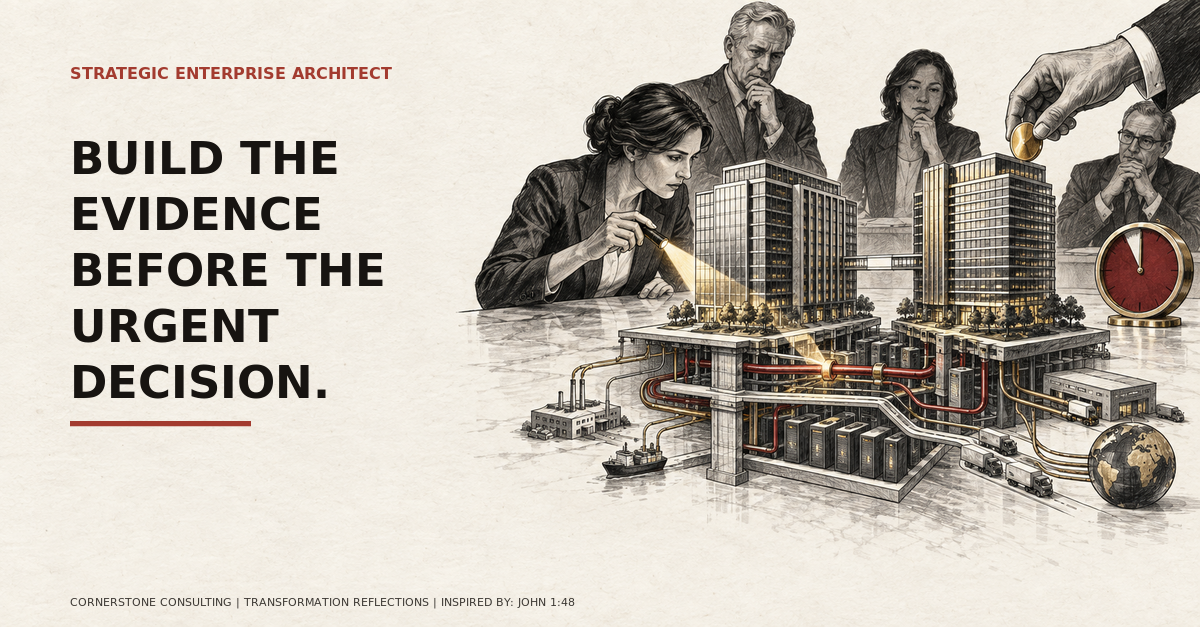
The board wants an acquisition answer in four hours.
There is no time to rediscover owners and dependencies.
The evidence must be ready before the request arrives.
I have seen executives ask for an architecture answer within hours of an urgent investment decision. The difference was never the size of the repository. It was whether current capability, dependency, ownership, and vendor evidence could be assembled quickly enough to improve the choice. Having a repository in place using a standard and consistent practice is key. I have used Avolution Abacus for over 15 years and it has consistently provided me with all the tools I need to support executive decisions.
Late architecture work exposes what was prepared long before the meeting.
An Enterprise Architect may receive only hours to assess an acquisition, divestiture, regulatory response, or failed supplier. At that point, the enterprise does not need a lecture about earlier engagement. It needs judgment that is already ready.
Urgency does not create trusted evidence, useful relationships, or a disciplined method. It reveals whether they exist. A crisis can expose that the capability map is stale, the technology inventory has no owner, vendor obligations are scattered, and business leaders know architecture only as a review function. It can also reveal the opposite: a current view of the enterprise, credible working relationships, and a concise way to frame consequences while choices are still open.
Imagine a board asking whether an acquisition can be integrated within the promised timetable. If architecture begins by interviewing everyone from scratch, the function becomes another delay. If the architect already understands critical capabilities, data boundaries, shared platforms, operating-model constraints, supplier dependencies, and decision rights, the first conversation can focus on the few assumptions that could change the deal.
This readiness is built in ordinary weeks. It comes from linking horizon scanning to real enterprise evidence, keeping a small set of decision views current, testing ownership, and learning which facts executives need when time is short. The goal is not an exhaustive repository. It is reliable orientation under pressure.
A useful discipline is a monthly decision-readiness drill. Choose one plausible urgent decision and ask: What would leaders need within four hours? Which evidence is already trusted? Which dependency would be hardest to confirm? Who can decide? Repair one weak point before the real request arrives.
Architecture practice enablement and coaching strengthen this quiet preparation. Independent transformation assurance can test whether the evidence survives scrutiny. Neither service replaces executive judgment; both make that judgment easier to exercise when the invitation comes late.
The crisis cannot create architecture readiness. It can only show whether the enterprise invested in it.
Reflection
What urgent enterprise decision would expose that your architecture evidence, relationships, or decision method is not ready?
Practice
Run a 45-minute decision-readiness drill for one plausible acquisition, supplier, regulatory, or resilience decision. Name the four-hour evidence pack, confirm owners and decision rights, and repair one missing or untrusted dependency view this month.
Comments Welcome
Darin Paton is the Owner of Cornerstone Consulting Inc., an Alberta-based enterprise architecture and SAP ERP transformation advisory firm serving organizations across complex business and technology change for over 15 years. 30+ years as an EA and advising SAP transformations.

Leave a Reply