

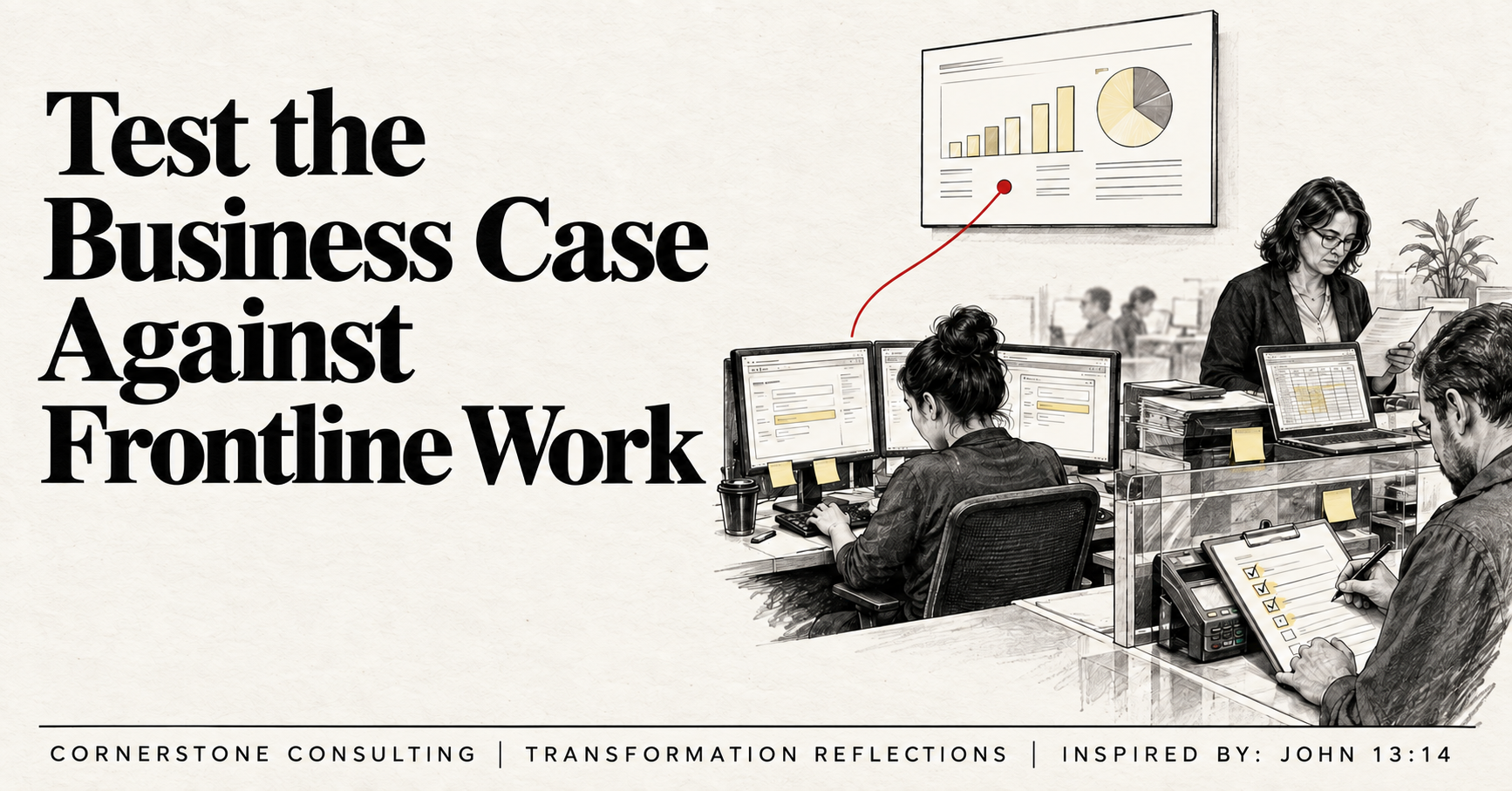
Your business case may be missing the work.
Teams are rekeying data, rebuilding reports, and carrying controls by hand.
Would you still approve the same design?
I have watched steering packs remain consistent while frontline teams quietly repaired data, reported in Excel, and carried controls by hand. The case only changed after leaders observed the work directly. That experience taught me that ordinary tasks often reveal investment drift before executive metrics do.
A business case can stay numerically tidy while the work beneath it changes.
Executives usually see a transformation through approvals, forecasts, risk summaries, and steering decisions. Those views matter, but they can miss the ordinary work that reveals whether the original case is still true. A service agent takes three extra steps to protect a customer. A supervisor keeps a private spreadsheet because the new control does not fit the operating rhythm. An analyst rebuilds data before every report. Each action is small. Together, they may invalidate assumptions about effort, capacity, adoption, control, or value.
This is why everyday work belongs in investment governance. It is not detail beneath executive attention. It is current evidence about the enterprise the business case is meant to change.
The danger appears when leaders wait for a major incident before they test that evidence. By then, workarounds may have become normal, costs may be embedded, and teams may be defending a forecast they no longer believe. The business case remains approved while the operating reality has quietly moved on.
A better response is a case-to-work review. Select several decision-critical claims from the approved case, then observe where those claims touch real work. Ask what employees must do today, what the process assumes, where data is repaired, which control is bypassed, and which dependency is carried by personal effort. Mark each claim confirmed, changed, or unknown.
Enterprise architecture can connect those observations across capabilities, processes, information, applications, controls, and decision rights. Architecture coaching helps leaders turn the evidence into a proportionate choice. Independent transformation assurance can test whether the change is local noise or a material reason to reshape scope, sequencing, funding, or ownership.
Strong leaders do not wait for a crisis to discover that the case has expired. They stay close enough to ordinary work to recognize changed conditions while useful options remain.
Reflection
Where is ordinary work telling you that a decision-critical assumption has changed, even though the approved case still appears stable? Which claim would you test by observing the work this week?
Practice
Run a 45-minute case-to-work review. Select five decision-critical claims from one approved business case. Observe the work where each claim should be visible, then mark it confirmed, changed, or unknown. Assign an evidence owner and decision date to every changed or unknown claim.
Comments Welcome
Darin Paton is the Owner of Cornerstone Consulting Inc., an Alberta-based enterprise architecture and SAP ERP transformation advisory firm serving organizations across complex business and technology change for over 15 years. 30+ years as an EA and advising SAP transformations.

Leave a Reply